Short answer
A gong bath (or sound bath) is a session in which you stay lying down, still and covered, immersed in the sounds and vibrations of the gong, the bowls and the chimes. You do nothing: no posture, no prescribed breathing. A session lasts around an hour and takes 7 people at most at Résonance, at 26 rue de Bassano, in the 16th. It's a practice of relaxation and rest, not medical treatment: the simplest way into sound therapy.
I get asked this at almost every first session, sometimes in a low voice, as if you were supposed to know already before daring to come. Good news: there's nothing to know. But let's explain anyway, because the words that circle around the gong bath are genuinely confusing.
Sound bath, gong bath, sound healing: what's the difference?
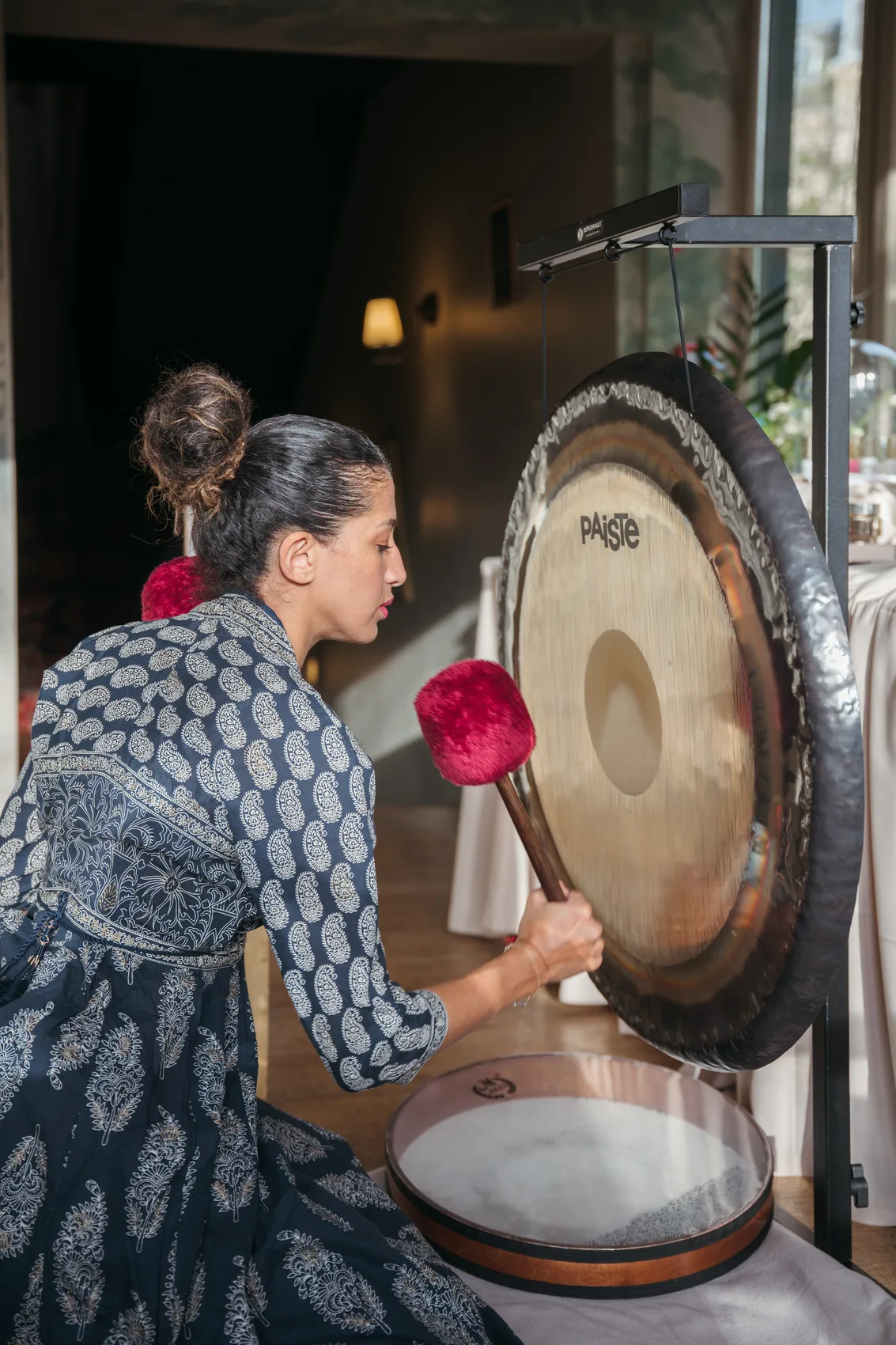
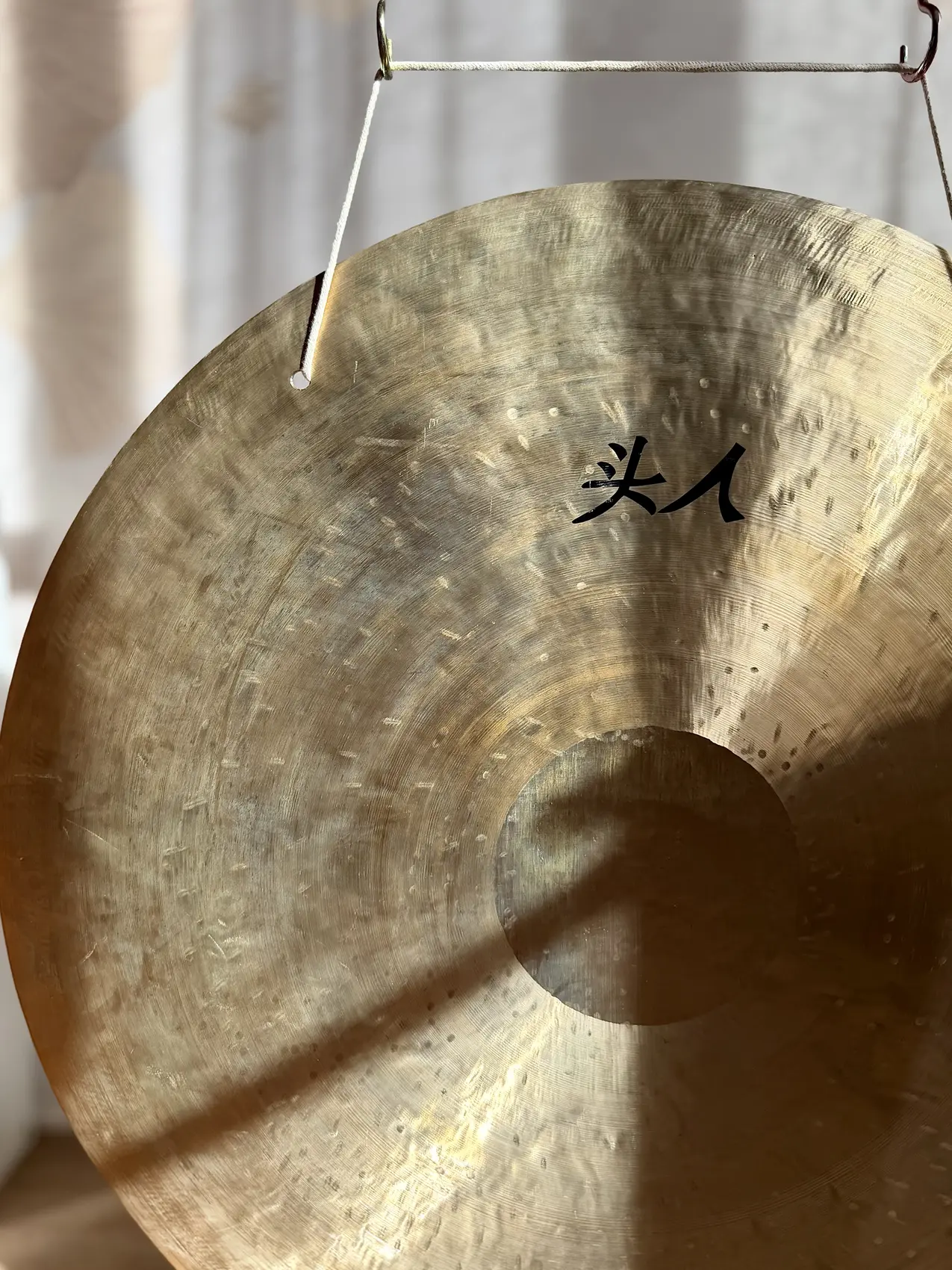
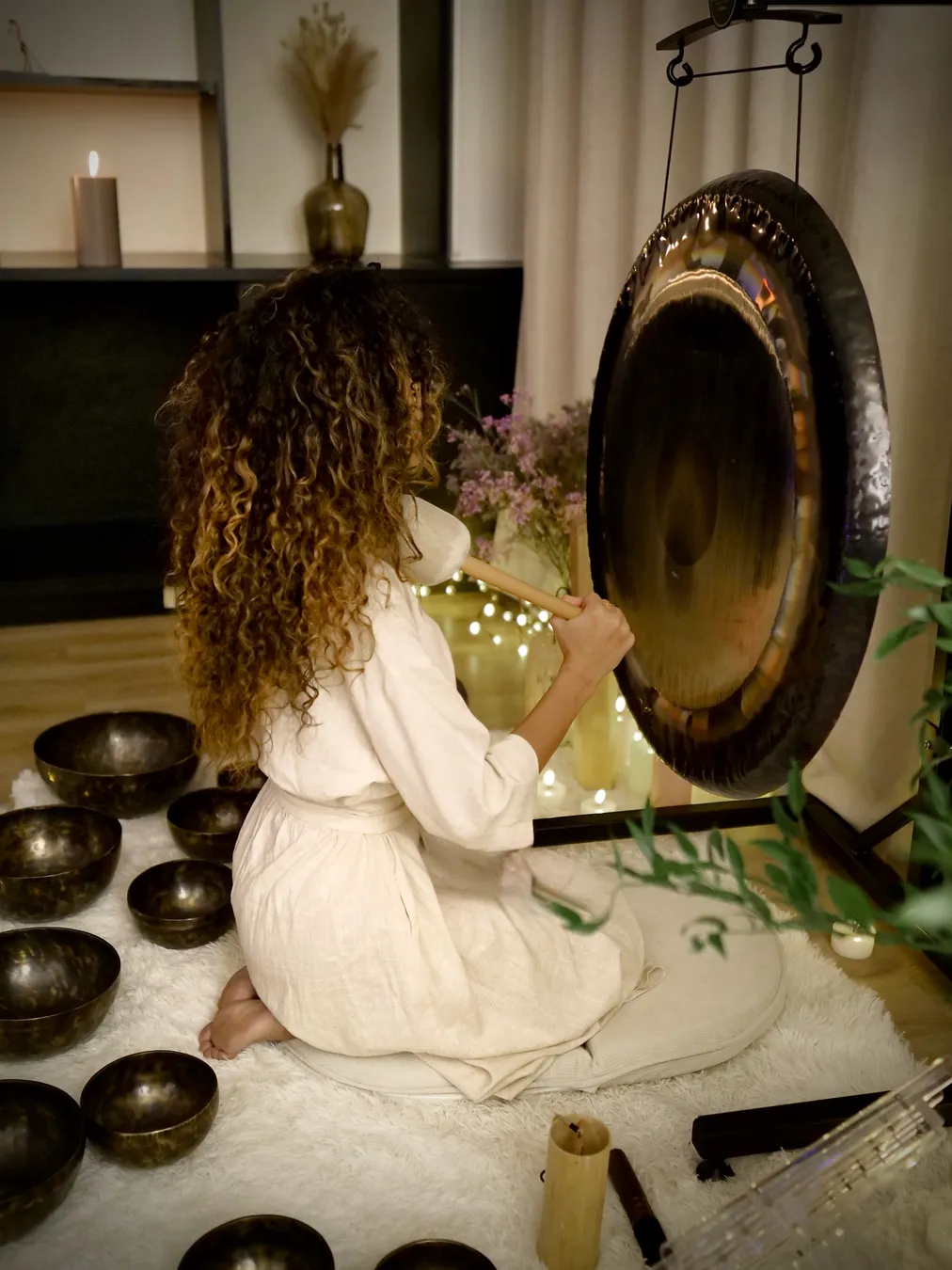
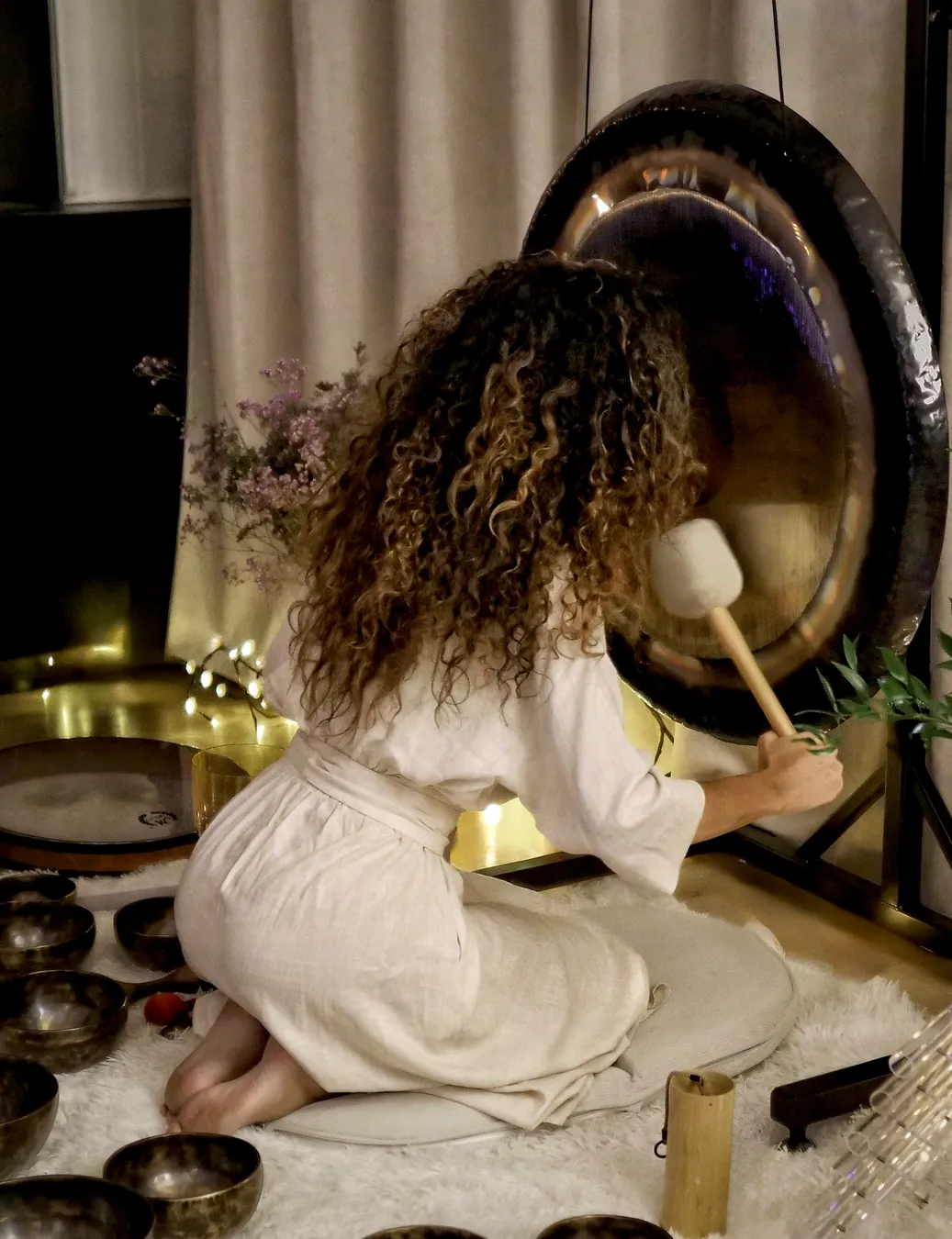
These names describe the same thing from three angles. Sound bath is the broadest term: you “bathe” in the sound. Gong bath puts the main instrument forward; the gong is a metal disc which, struck gently and then rubbed, produces a rich, shifting bed of frequencies. Sound healing is the wider label, picked up all over Instagram. In practice, when you book a gong bath in Paris, you get roughly the same hour, whatever name is written on the page.
Where does the gong bath come from?
The gong is an ancient instrument. It has been played for centuries across Asia (the word itself comes to us from Indonesia) to mark time, to gather people, to accompany ceremonies. What we now call a “sound bath” is more recent: a contemporary wellbeing practice that grew out of those instruments meeting a very modern want, which is somewhere to genuinely stop.
Worth saying straight away, because the practice sometimes carries a mystical reputation that isn't ours: at Résonance there's no talk of chakras, of energies to rebalance, or of promises. The gong bath as we offer it is a deliberately plain sensory experience. Sound, vibration, silence. The rest is your business, and your body's.
How does a session run?
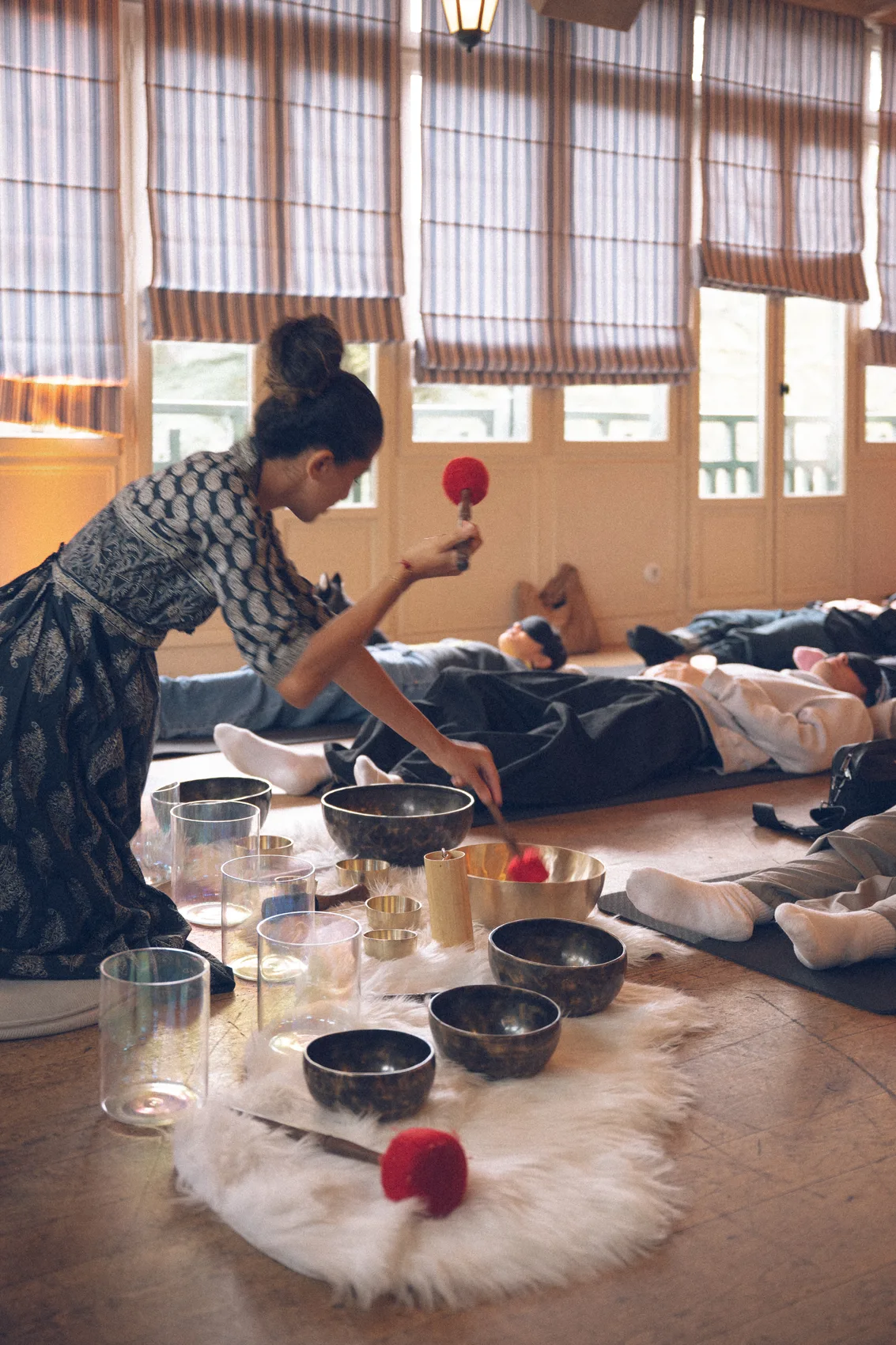
It all begins with a quiet welcome. You're settled on the floor, on a mat, with a blanket and a cushion. Body temperature drops when you stay still, so we cover you well. A short introduction explains what's coming, then the quiet settles and the first sound rises. During the immersion, close to 45 minutes, you have nothing to manage: you listen, you breathe at your own pace, and you let the vibration find its way. The session closes with a gradual return and time to integrate, that slightly cotton-wool moment where you sit up before meeting the street again.
The thread through it is four simple movements: breathe, connect, release, restore. That's deliberately unspectacular. The work happens when you stop trying, not when you try harder: there's no goal to reach and no “right” way to experience the session. If you're coming for the first time, the article your first sound bath: what to expect sets out each stage, what to wear and when to arrive.
Which instruments do you hear in a gong bath?
Each instrument has its place. Here are the main ones and what they bring to the session.
| Instrument | Sound | Role in the session |
|---|---|---|
| Gong | A broad metallic bed, long vibrations | The heart of the session, holding attention continuously |
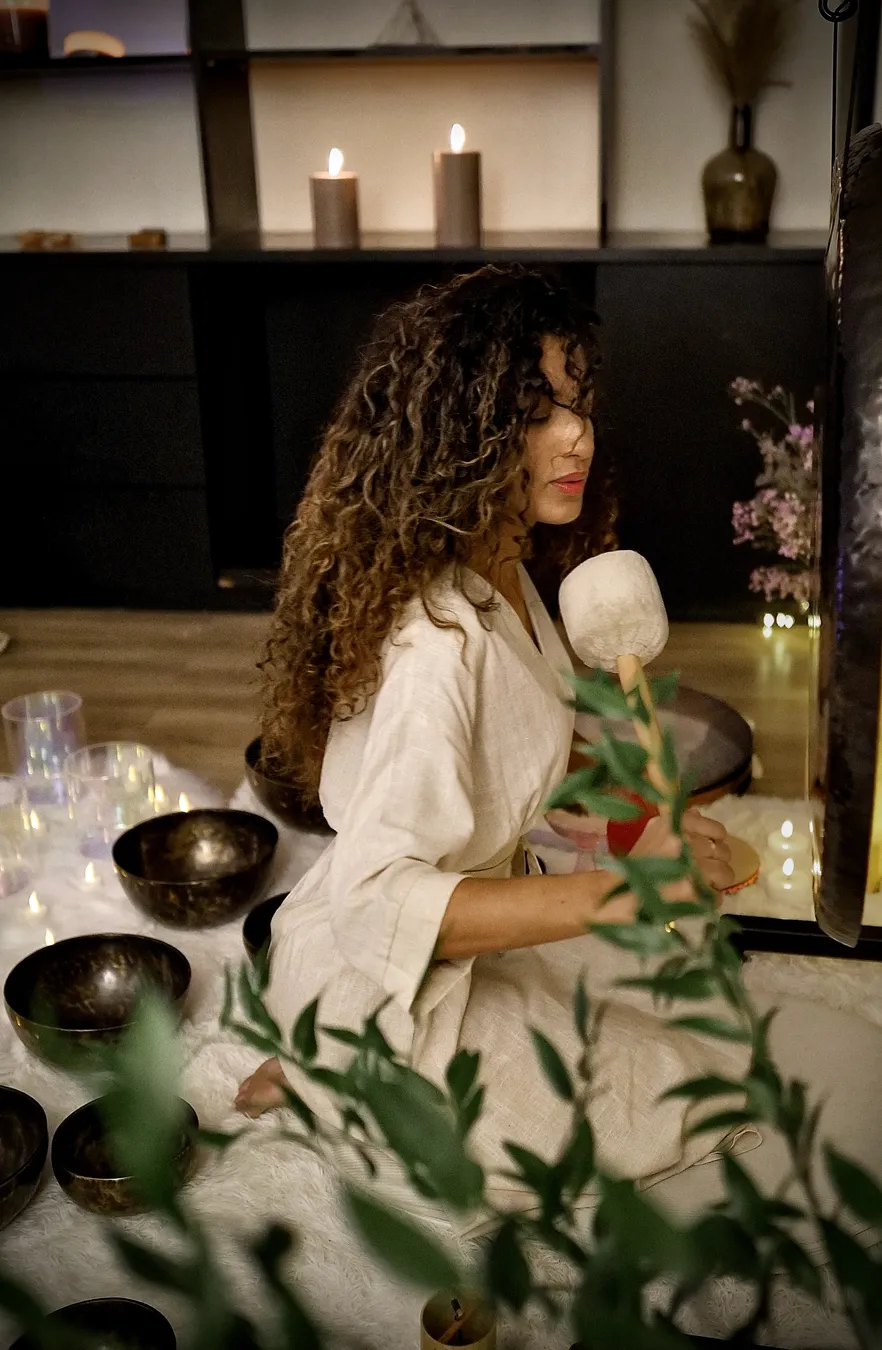
| Tibetan bowls | Round, sustained notes, in metal | Set the anchor points, opening and closing phrases |
| Crystal bowls | Clear, almost crystalline timbre | Bring transparency and height |
| Chimes / koshi | Small, high, shimmering touches | Mark transitions, lighten the passages |
When those bowls are placed directly on the body in a one-to-one session, it's called a sound massage with Tibetan bowls, another way of receiving sound.
Is a gong bath a form of meditation?
In a way, yes, but a meditation that asks nothing of you. Where classical meditation invites you to keep returning to the breath or to an instruction, the sound bath does the work for you: the sound occupies your attention. You don't have to “empty your mind”, count your breaths, or fight the thoughts that pass through. They pass, the sound stays, and the mind ends up settling almost without noticing.
That's why so many people who have “never managed to meditate” feel at ease from the first time. There's no technique to fail at. You could call it a meditation guided by sound rather than by words: a gentler way in, especially when the mind is used to moving fast.
What does a sound bath feel like?
Accounts vary a great deal, and that's normal. Many describe a pleasant heaviness, the sense of sinking into the floor. Some fall asleep for a few minutes. Others see images, or feel tingling where the vibration passes. A few feel “not much” at the time, then notice an unfamiliar calm in the hours that follow. All of it is part of the experience. Sound acts on attention and on the nervous system; there's no single right way to do it.
It also happens that a session stirs something: an emotion rising, a tightness in the throat. Nothing alarming. In a calm, covered setting, the body sometimes allows itself to release what it had been holding. We don't chase that effect, and we don't avoid it either. What a gong bath is not, on the other hand, is medical treatment. We don't promise to cure, to treat a condition or to guarantee a result. What we offer is a precise, well-held hour in which the body can rest. That's the whole of it.
What the research says
Since we're talking about honesty: serious studies on sound baths are still rare, and shortcuts are best avoided. What can be said fits into a few careful lines.
The most frequently cited study is Goldsby et al. (2017): 62 people, a session of about an hour of singing bowls (with some crystal bowls, gong, tingshas and bells), and, immediately afterwards, a self-reported drop in tension, anger, fatigue, low mood and anxiety. An interesting detail: people new to the practice reported a more marked drop in tension than regulars did. That's encouraging, but it's an observational study, with no control group, on a single session. It describes what people feel; it doesn't prove that sound is the cause, and it relied mostly on bowls rather than the gong.
More broadly, the NCCIH, the American health agency for complementary approaches, considers that meditation practices can help with stress and relaxation, while noting that “much of the research on these topics is preliminary”. In other words: a sound bath can support a state of relaxation, without being a treatment. That's exactly where we set the bar.
Our position: honest rather than spectacular. You won't hear us talk about “frequencies that heal” or miracle numbers. The gong bath opens a door towards rest; that's already a great deal, and it's verifiable, lying down.
“The body doesn't need convincing, only putting in the right conditions.”
Who is it for?
For the curious, the tired, people who sleep badly, those who can't seem to stop. We see as many complete beginners as regulars, executives from the neighbourhood and people who've come from further afield. No prerequisites: you don't need to be flexible, sporty or “spiritual”. Before booking, do have a look at the precautions and contraindications: a gong bath isn't suitable in certain situations (epilepsy, a pacemaker, severe hearing conditions, certain stages of pregnancy, among others).
Otherwise, all you need to do is choose a format on the pricing page and come with a free mind. A first group session starts at €39; if you'd prefer a face-to-face setting, the one-to-one session exists too.
Key points
- A gong bath (or sound bath) is experienced lying down, still and covered, immersed in the sound of the gong, the bowls and the chimes. Nothing to do, no technique to learn.
- A session lasts around an hour and takes 7 people at most at Résonance, at 26 rue de Bassano.
- It's a meditation guided by sound rather than by words: accessible even to anyone who has “never managed to meditate”.
- It's a practice of relaxation and rest, not medical treatment: no promise of a cure or a result.
- The research (Goldsby, 2017) is encouraging but limited: observational, with no control group.