Short answer
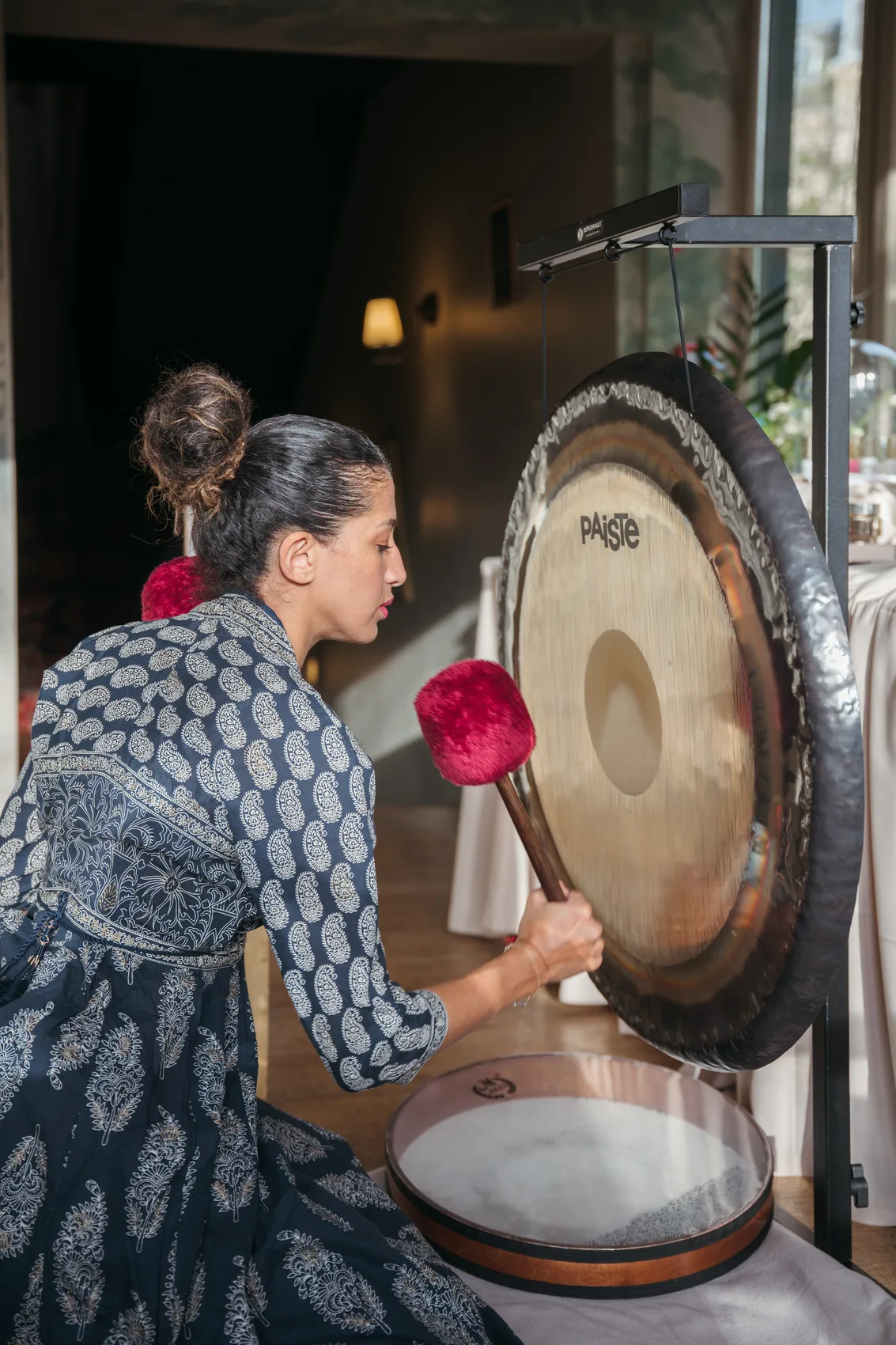
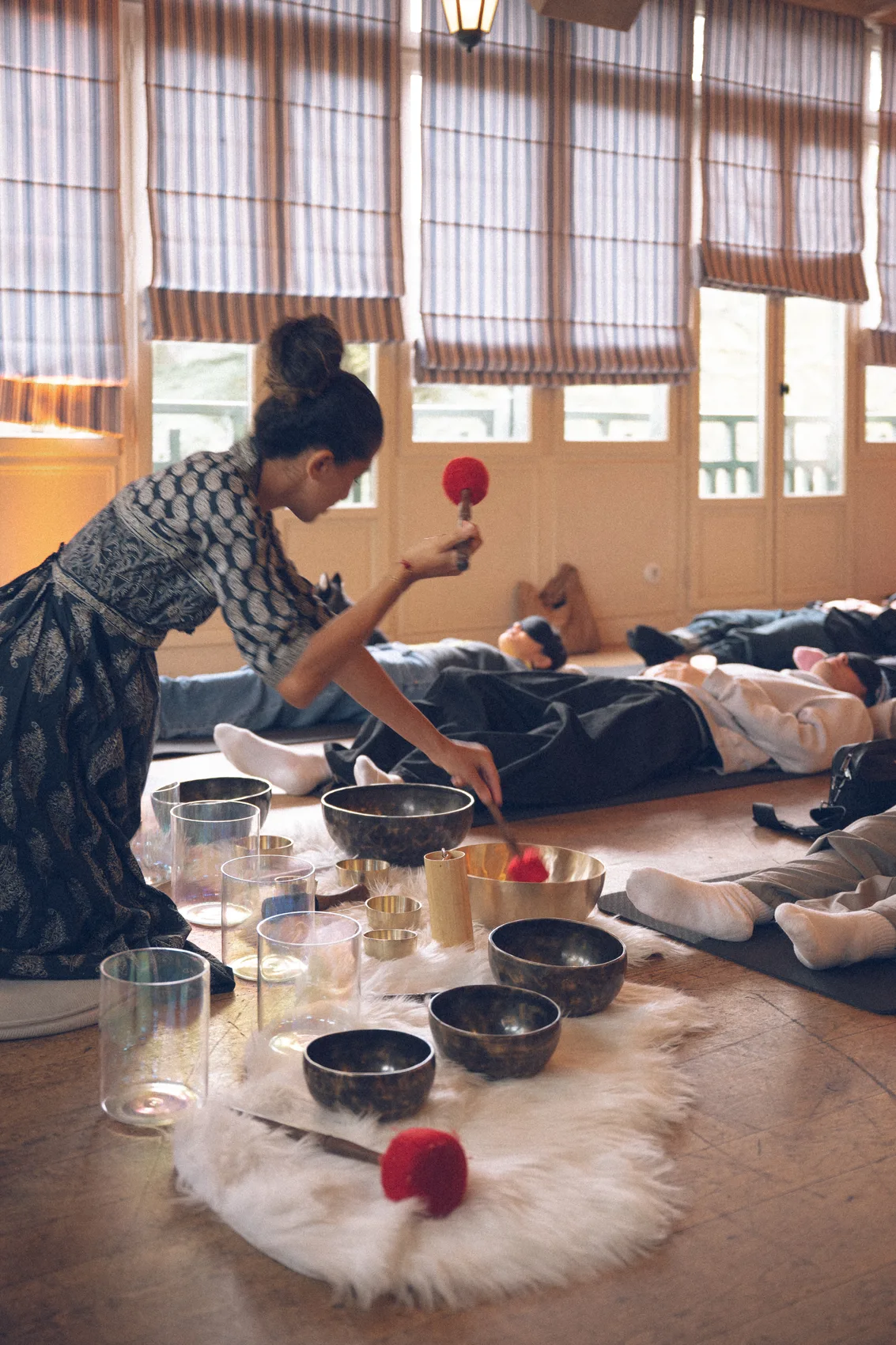
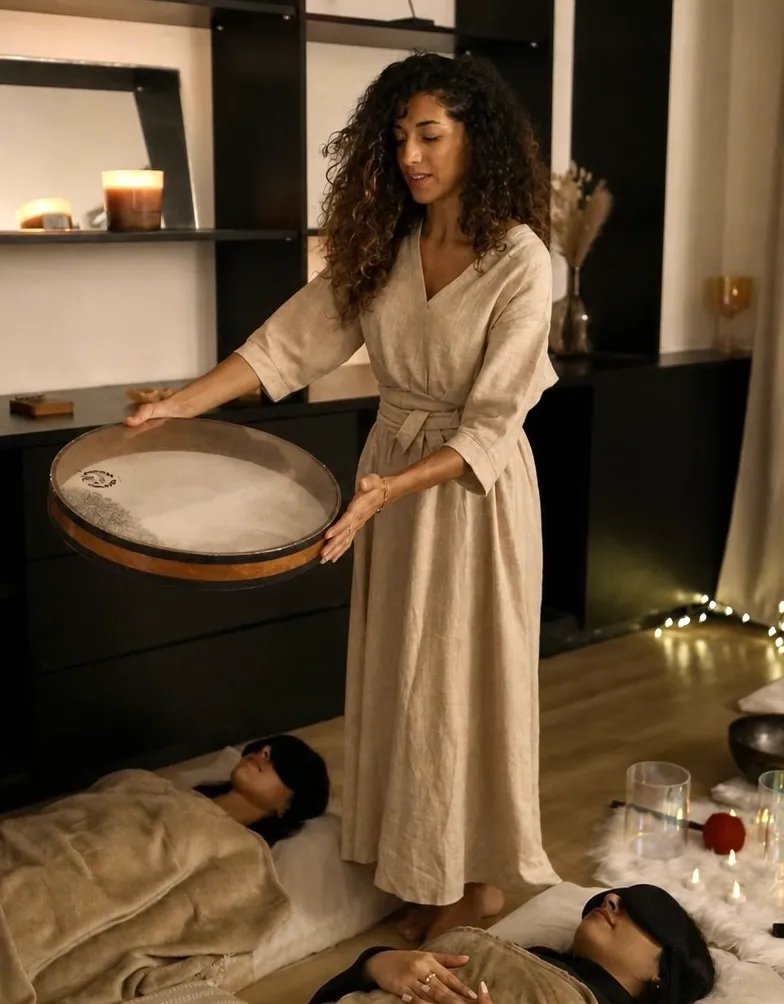
A sound bath gives attention something stable to follow, which helps the body leave the alert state and enter recovery mode. In practice, lying still, breathing often slows, and research associates slow breathing (around six cycles a minute) with a rise in parasympathetic activity, the “rest” branch of the nervous system. We're talking about support for stress regulation and rest, not medical treatment. A session lasts around an hour, lying down, at 26 rue de Bassano. For the group version, see the gong bath in Paris.
We live with a foot on the accelerator. The 16th is no exception: tight calendars, notifications, decisions one after another. The body, for its part, doesn't distinguish between real danger and an overflowing inbox. It stays on alert. That's where you have to start to understand what a sound bath actually does, and, equally, what it doesn't.
Why does the body stay “switched on”?
Our nervous system manages, in the background and without our thinking about it, the rhythm of the heart, breathing, digestion, muscle tension. That automatic part is called the autonomic nervous system. The problem with urban life isn't action: it's never really coming down again. We string days together without giving the body time to switch into the other register. Over time, rest becomes a skill we unlearn.
Sympathetic and parasympathetic: two modes, one balance
The autonomic nervous system runs on two branches. The sympathetic branch is “action” mode: faced with anything demanding vigilance, it speeds up the heart and the breath and puts the muscles under tension. The parasympathetic branch is “recovery” mode: it slows the heart rate, calms the breath, restarts digestion. It's often summed up in two familiar phrases: fight-or-flight for the first, rest-and-digest for the second.
One point deserves saying plainly, because you often read the opposite: the sympathetic isn't “bad” and the parasympathetic isn't “good”. You need both. What counts is their balance, the constant back and forth between mobilisation and rest. Chronic stress breaks that pendulum: we stay too long on the action side. A relaxation practice therefore isn't trying to “switch off” the sympathetic, only to give the body back access to the other side.
The vagus nerve: the body's brake
If the parasympathetic has a conductor, it's the vagus nerve. It's a long nerve linking the brainstem to the heart, the lungs and the digestive system, a two-way channel of communication between the brain and the body. It takes part in slowing the heart rate, modulates breathing and continually carries information from the gut to the brain. Nothing esoteric about it: it's anatomy, well established.
It's what comes next that needs precision. A widely used framework, the polyvagal theory of Stephen Porges, proposes that the nervous system continually “reads” signals of safety or danger around us (a mechanism he calls neuroception) and adapts our state without our deciding. The theory is illuminating as a language, and the Polyvagal Institute makes a useful teaching model of it. But it's a model, debated in the scientific literature, not a truth carved in stone. We use it as a telling image, never as proof.
How does sound help the body come down?
Sound doesn't “treat” anything by itself. What it offers is a foothold. A continuous, enveloping bed, with no threatening surprises, tells the body that for now there's nothing to monitor. Attention settles on the vibration rather than on the list of things to do. Deprived of any reason to stay on guard, the nervous system lets go. That's the whole point of sound therapy: creating an environment stable enough for rest to become possible again.
Lying still and covered counts as much as the sound does. Posture already sends the signal that you can let go. And then something quiet but important happens: the breath lengthens. No clever breathing is asked of you, but in the quiet, with nothing to do, it slows by itself. And that's precisely where the scientific data is firmest. We come to it in a moment. Sound forces nothing; it sets up the conditions, and the body takes care of the rest.
Two modes, two states of the body
Schematically, here's what separates the alert state from the recovery state.
| Marker | Alert state (sympathetic) | Recovery state (parasympathetic) |
|---|---|---|
| Breathing | Short, high, fast | Slow, full, low |
| Heart rate | Raised | Slowed |
| Attention | Scattered, anticipating | Settled on the present |
| Muscles | Under tension | Released |
| Digestion | Paused | Restarted |
| How you feel afterwards | Fatigue building up | Calm that carries on |
A sound bath doesn't force the move from one to the other. It simply makes the switch easier.
“Slowing down isn't losing time. It's finding your measure again.”
What the research says
I'm often asked whether “all of this is proven”. The honest answer fits in one sentence: partly, and you need to know what you're talking about. Worth separating three levels here, from the most solid to the most fragile.
The anatomy isn't in dispute. How the sympathetic and parasympathetic branches work, the role of the vagus nerve in slowing the heart: these are facts of physiology taught everywhere. On that, no particular caution is needed.
Meditation and mindfulness help, but the evidence remains partial. The NCCIH (the American health agency for complementary approaches) states that meditation can help with stress, anxiety and sleep, while noting that “much of the research on these topics is preliminary”. A 2019 analysis of 18 studies (1,654 participants) found that mindfulness meditation improved sleep quality more than educational programmes did, without outperforming reference approaches such as cognitive behavioural therapy or exercise. In fairness, the other side deserves stating too: a 2020 review (83 studies) noted adverse effects in a minority of practitioners, mostly anxiety. Relaxation isn't guaranteed for everyone, and that's normal.
On sound specifically, the data is encouraging but thin. The most cited study is Goldsby et al. (2017): 62 people, a session of about 60 minutes of singing bowls (with some crystal bowls, gong and chimes), and, immediately afterwards, a self-reported drop in tension, anger, fatigue, low mood and anxiety. That's interesting, but it's an observational study, with no control group and on a single session. In other words: it describes what people feel, it doesn't prove that sound is the cause, and it can't rule out the effect of expectation or of simply lying down for an hour.
The best-documented lever is breathing. A 2022 meta-analysis (Laborde et al.) shows that voluntary slow breathing increases vagal control of the heart, measured through heart rate variability, with an optimum around six breaths a minute. A sound bath imposes no breathing pattern; but lying down, attention resting on the sound, you spontaneously breathe more slowly. It's there, at the junction of sound settling attention and breath lengthening, that the physiology is most convincing.
Our position is simple: we'd rather be honest than spectacular. You won't hear us praising “frequencies that heal” or miracle numbers. Sound opens a door; that's already a great deal.
What a sound bath doesn't do
We'll say it plainly, because a premium room is judged on its frankness too. A sound bath is not a treatment for anxiety, insomnia or depression. It replaces neither medical care, nor psychological support, nor medication. If a difficulty is established, the right step is to speak to a health professional: sound can come alongside, not instead. And because the practice doesn't suit everyone, a few contraindications are worth knowing before you book.
Key points
- The autonomic nervous system has two modes: action (sympathetic) and recovery (parasympathetic). Urban life keeps us too often on the action side.
- Sound gives attention a stable foothold; the body, reassured, can let go. Lying still counts as much as the sound itself.
- The best-evidenced physiological lever is slow breathing, which increases parasympathetic activity (the vagus nerve).
- Research on sound (Goldsby, 2017) is encouraging but limited: observational, with no control group.
- A sound bath supports relaxation and rest. It is neither a treatment nor a promise of a result.
Why does the effect carry on after the session?
It's the most common observation: the real calm often arrives afterwards, not during. On the way home, in the evening, sometimes at night. Not surprising: once under way, recovery keeps doing its work. For some, that translates into falling asleep more easily, a subject taken up in the article gong baths and sleep. For others, it's just a next day that sits a little less tight. We promise no result; we observe tendencies.
If you're new to the practice, the article what is a gong bath lays the groundwork, and the safety & care page gathers the few contraindications worth knowing before you book.