Short answer
Sound therapy is a practice of relaxation through sound: gong, bowls and chimes are used to help the body slow down and shift into rest. It isn't medical treatment and nothing is guaranteed. What's worked on is the quality of the hour itself. It differs from music therapy, which is a regulated care practice. At Résonance it's experienced in a group (the gong bath, from €39) or one to one (the sound massage, €95), at 26 rue de Bassano, in the 16th.
This guide gathers what I'm asked most often, in sessions and by email. I wrote it so it can be referred to before coming, without jargon and without promises. Start at the beginning.
What is sound therapy, exactly?
Sound therapy covers the practices that use sound and vibration to encourage relaxation and rest in the nervous system. The principle is old and fits in one sentence: a stable, enveloping sound environment gives attention something to follow, which helps the mind settle. The body, for its part, no longer has reason to stay on alert. It lets go. This is a wellbeing practice, not a medicine: sound therapy doesn't claim to cure illness or replace treatment.
In Paris, the word covers several formats. The best known is the group gong bath, where you lie down in a small group. Then there's the private session, one to one and personalised, and the sound massage with bowls placed on the body. All rest on the same idea: create the right conditions, then let things happen. No performance is expected of you, quite the opposite.
Where does sound therapy come from?
Sound has accompanied contemplative practices for a very long time. So-called “Tibetan” bowls come from the Himalayas, gongs run through the cultures of Asia, and voice, drum and bells set the rhythm of rituals on every continent. Nothing new, then, in the idea that sound affects an inner state. What is recent is the way the West took up these objects to make an urban wellbeing practice of them, detached from any religious setting.
That lineage deserves to be described soberly. You sometimes read grand accounts of “thousand-year-old traditions” supposed to explain everything. The truth is simpler: old instruments, attentive listening, and a setting built for rest. That's already enough. We don't need mythology to justify an hour lying down in the quiet.
Music therapy, sound therapy, sound healing: what's the difference?
One misunderstanding comes up often, so let's clear it straight away. Music therapy and sound therapy are not the same thing. Music therapy is a regulated care practice: it's delivered in clinical settings (hospitals, psychiatry, care homes, specialist services) by trained professionals, with university qualifications and a code of ethics, working with people who have psychological, sensory or neurological difficulties, or psychosocial ones. The French Federation of Music Therapy defines it as “a practice of care, of helping relationship, of accompaniment, of support or of rehabilitation”.
Sound therapy (the sound bath, sound healing) belongs instead to wellbeing and relaxation. It isn't a regulated health profession: there's no state qualification and no protected title, and above all, it isn't medical treatment. It never replaces advice or care. We hold to this distinction, because it protects your trust as much as our honesty. A premium practice isn't the one that promises most; it's the one that says clearly what it is.
Which instruments are used?
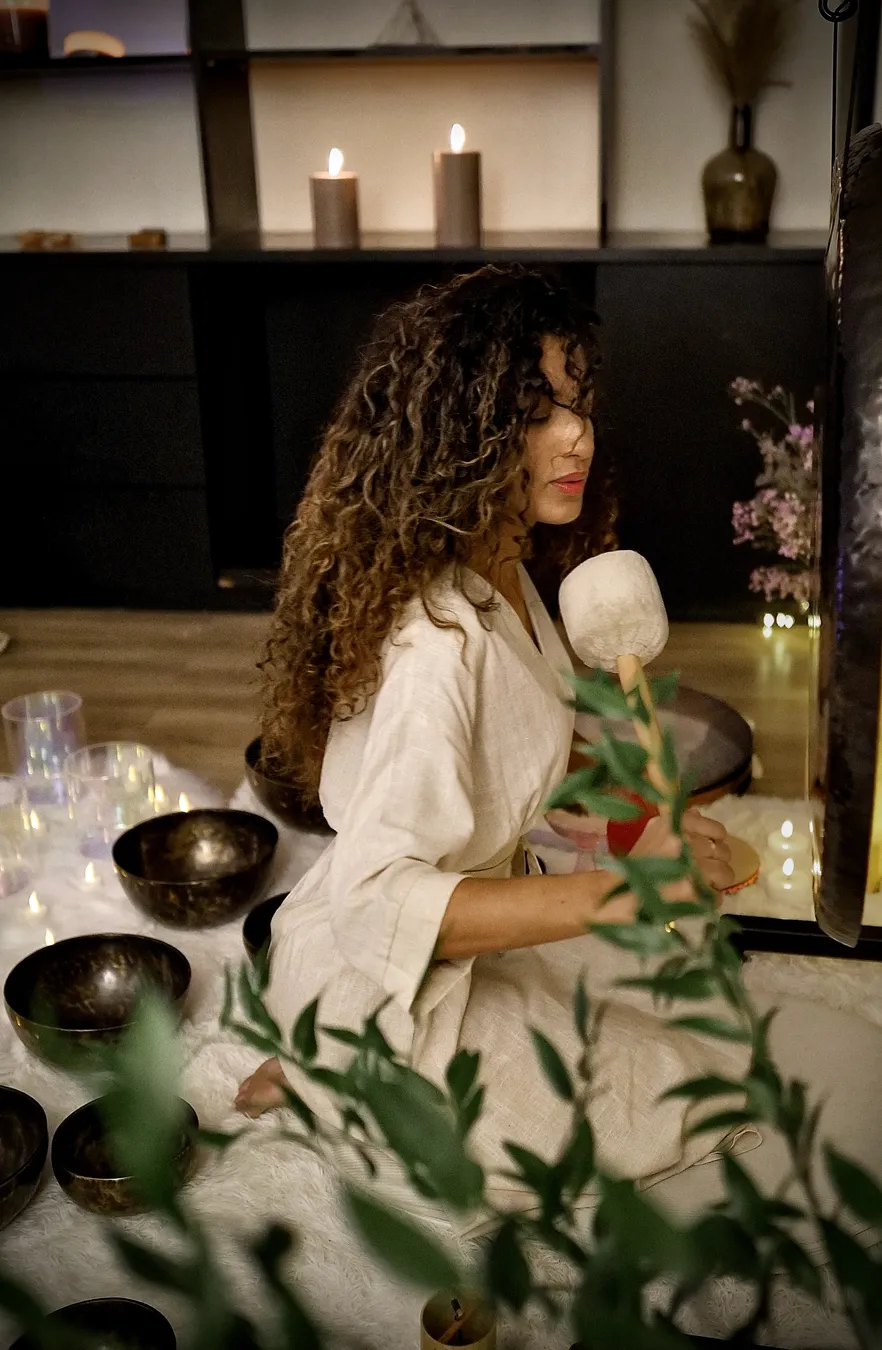
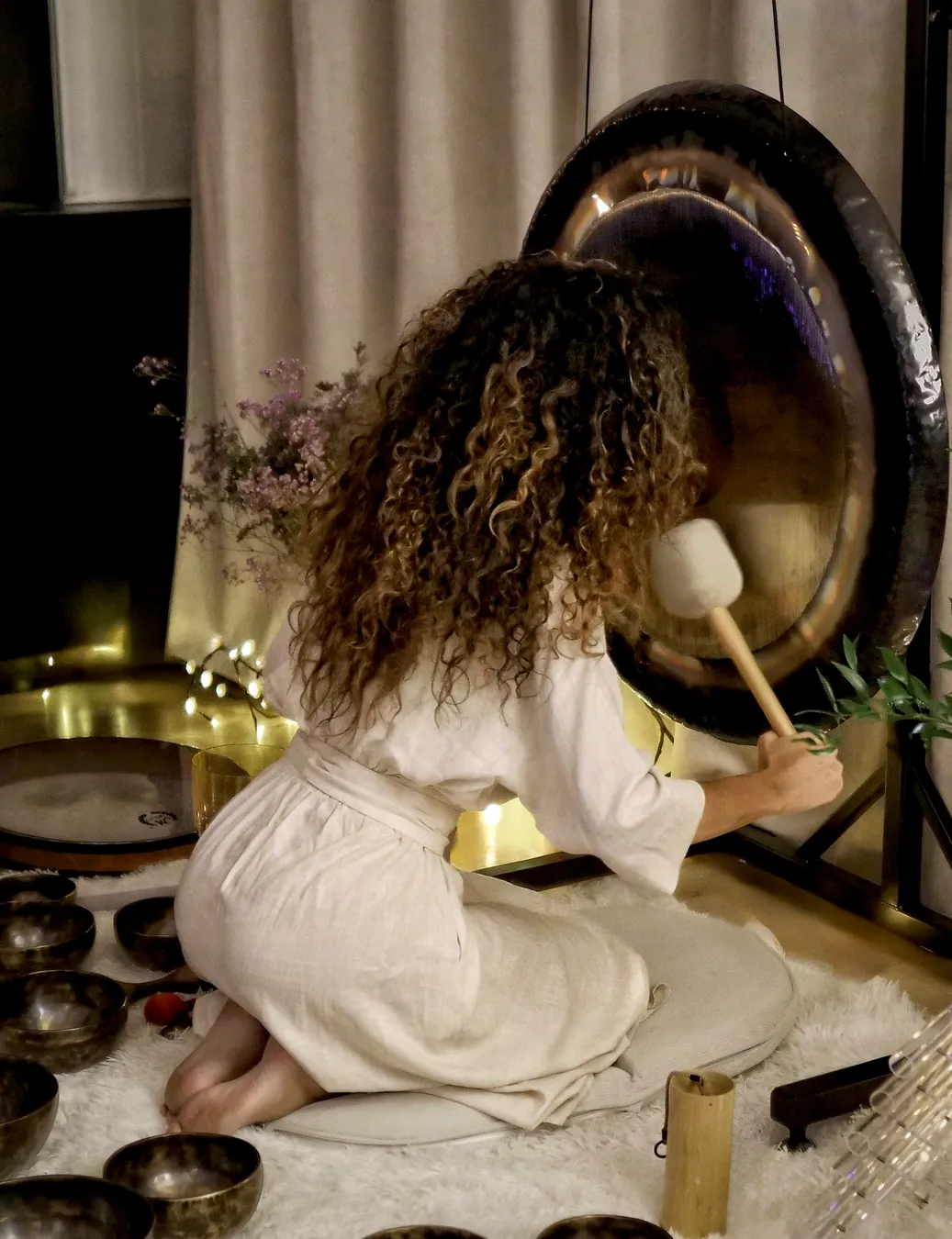
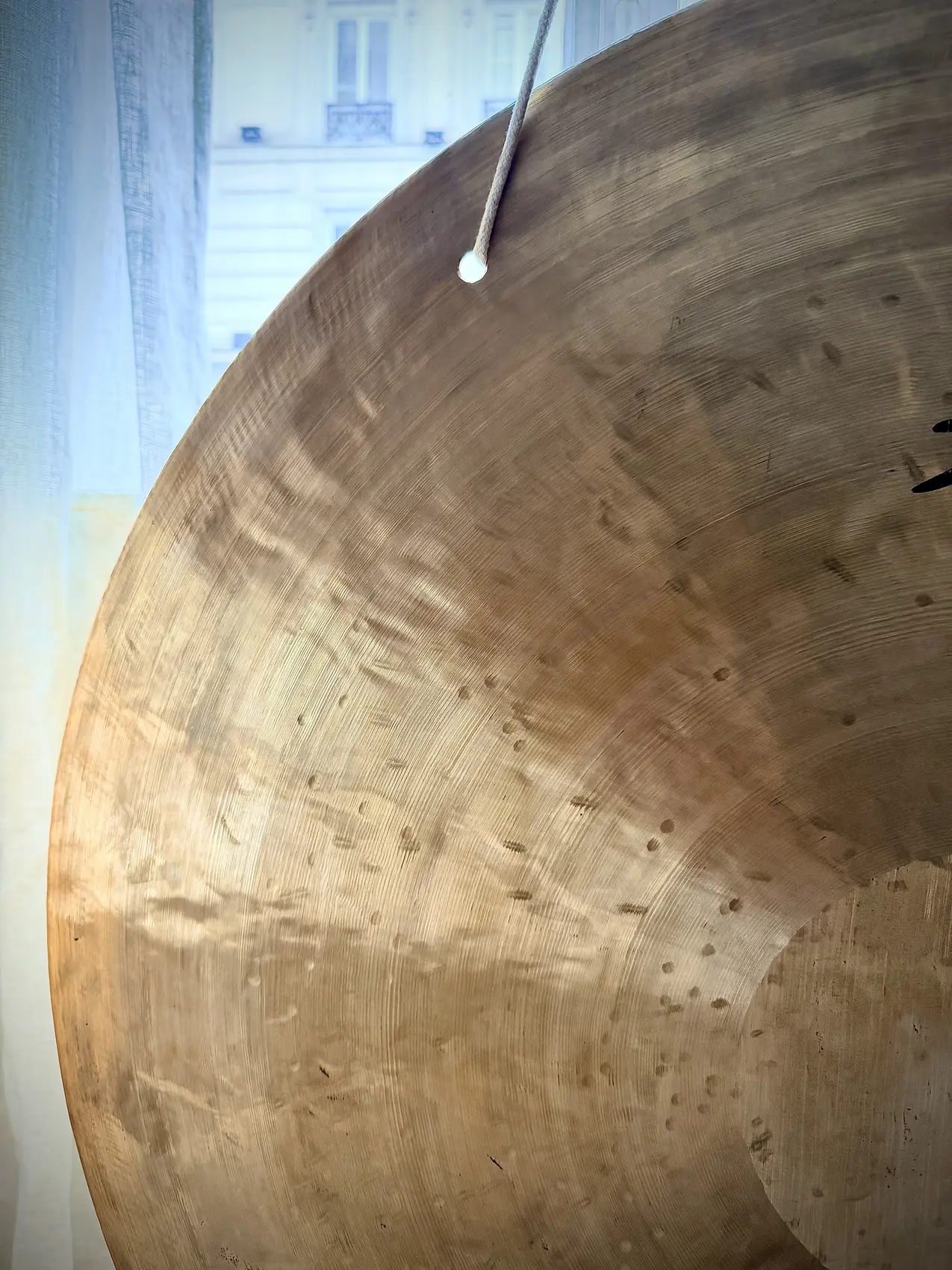
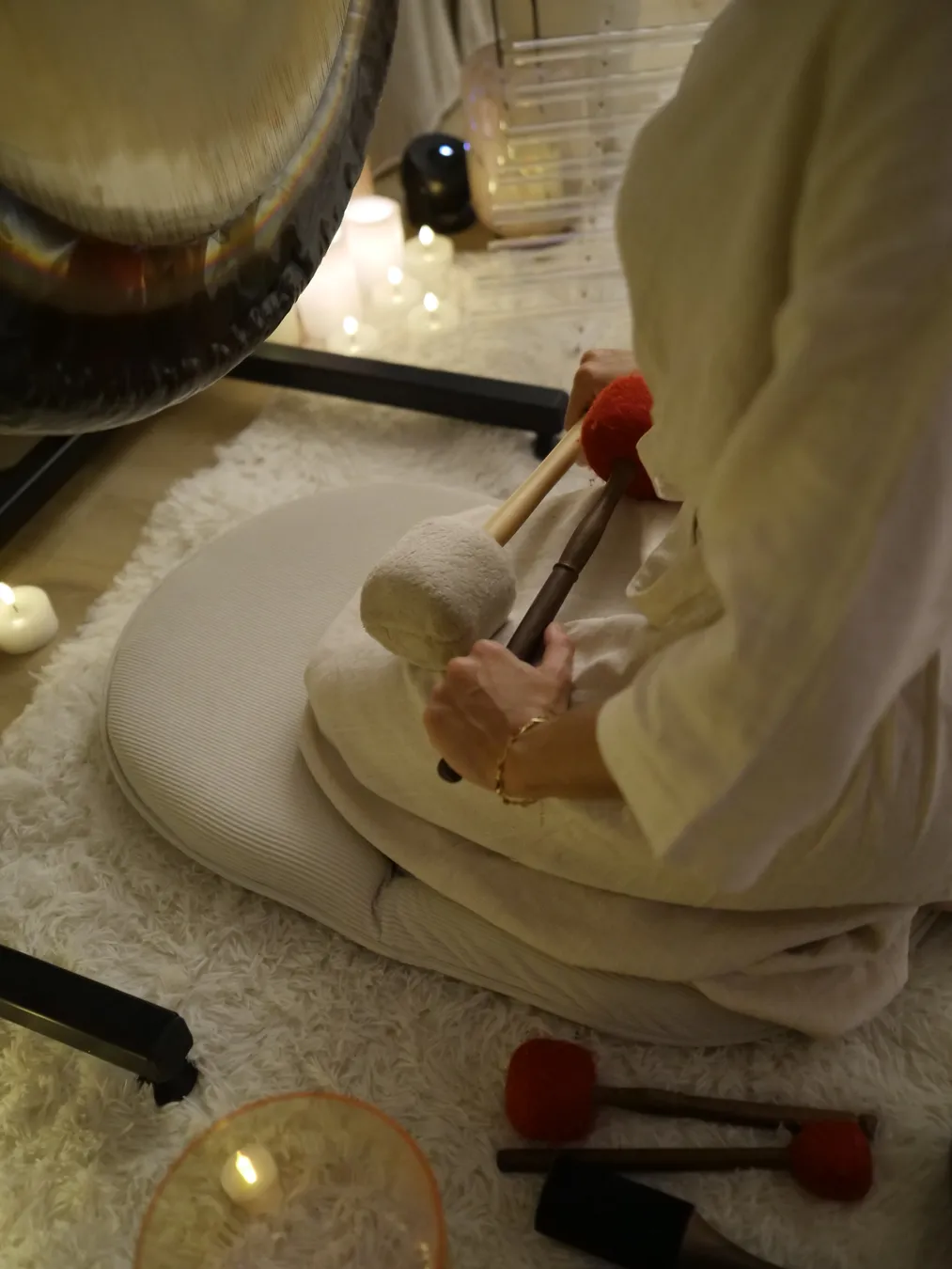
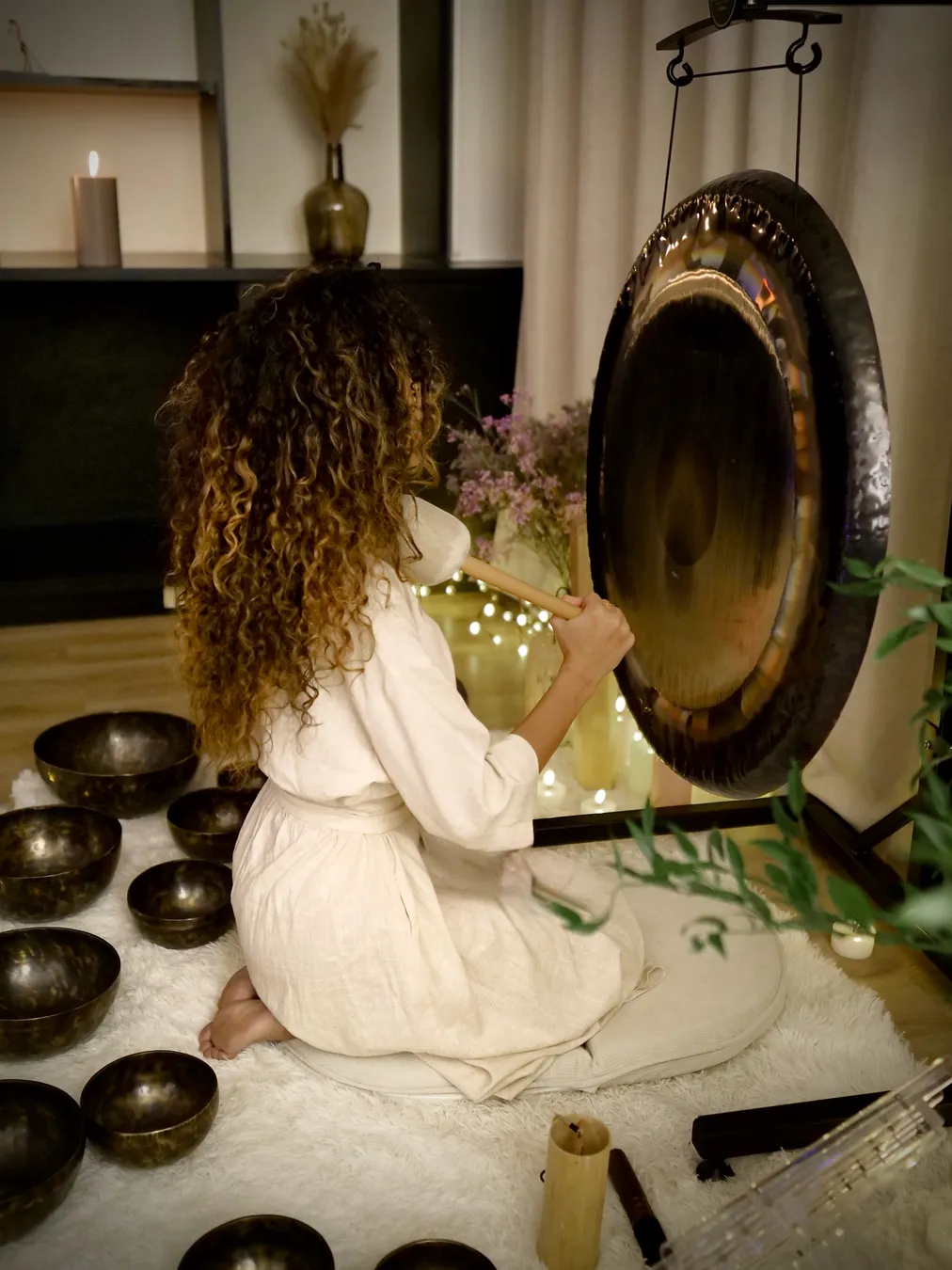
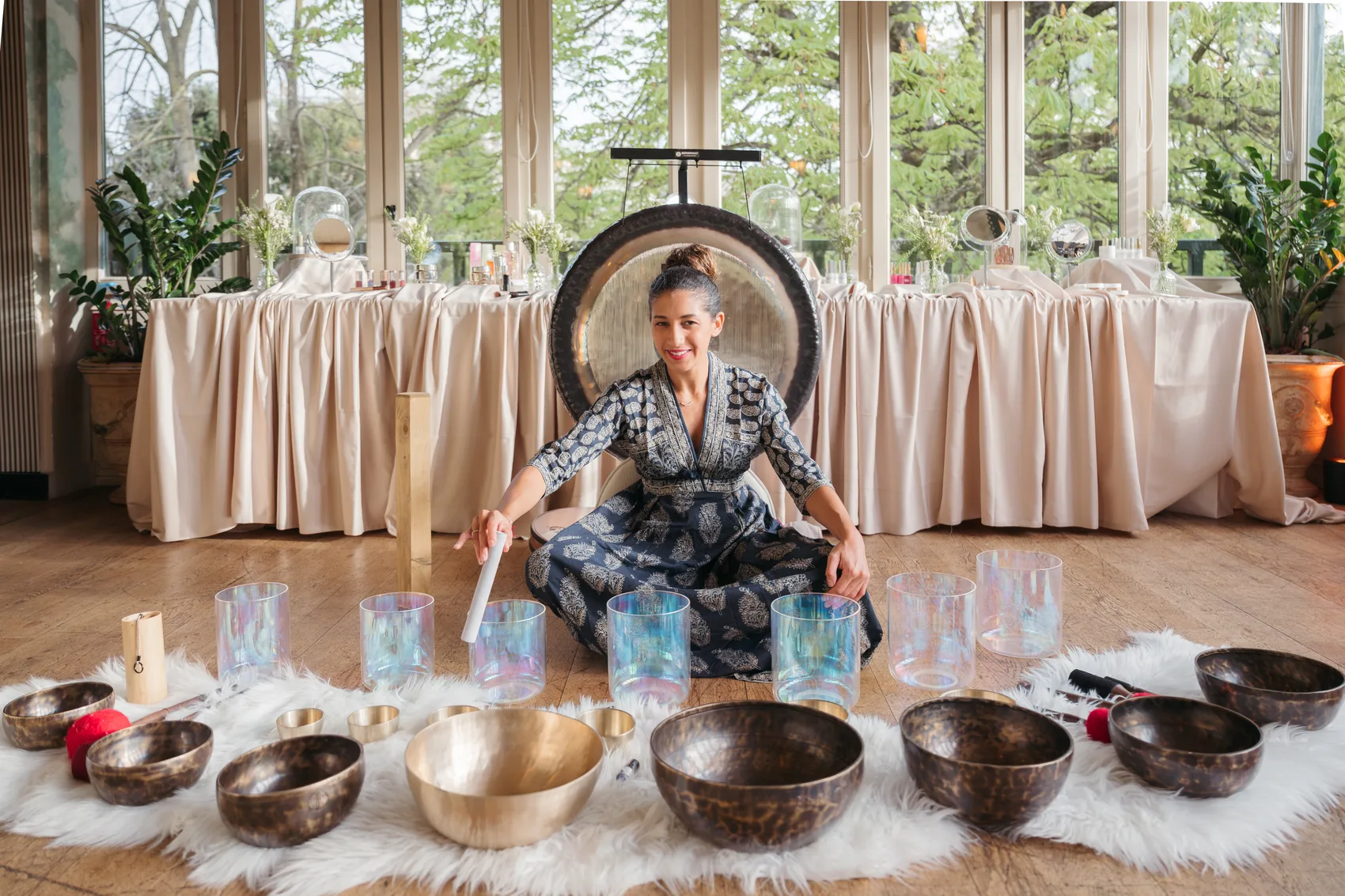
The gong holds the central place. It's a large metal disc which, played patiently, produces a shifting bed of frequencies, never quite the same twice. Around it, the bowls (Tibetan or crystal) set sustained notes, rounder or clearer depending on the material. The chimes and koshi add fine, high touches that mark the transitions. None of it is a musical performance: the point is to weave a continuous texture, not to play a piece.
Each material has its grain. The metal of the gong carries far and vibrates for a long time; the Tibetan bowl, hammered by hand, has a warm, slightly irregular timbre; the crystal bowl, purer, seems almost to float. We're not after virtuosity but support: giving the ear something to settle on, with no jolt or surprise. When those bowls are placed directly on the body, one to one, it's called a sound massage with Tibetan bowls.
How does sound act on the body?
Sound doesn't “treat” anything by itself. What it offers is an anchor point. A continuous bed occupies attention, which then stops chasing the list of things to do. Deprived of any reason to stay on alert, the body relaxes: breathing often lengthens, shoulders drop, the pace slows. That mechanism, the shift from the alert state to the recovery state, is explained in detail, with sources, in the article sound baths and the nervous system.
Posture counts as much as sound. Lying still and covered already sends the body the signal that it can let go. No clever breathing is expected of you, no difficult posture. We simply put you in the right conditions, and the rest happens almost without you.
Which format should you choose?
All three rest on sound therapy, but they don't feel the same from the inside.
| Format | Setting | You | Best for | Price |
|---|---|---|---|---|
| Group gong bath | Small group, lying down | You listen | Switching off deeply | from €39 |
| Private session | One to one, personalised | You talk, then receive | Tailored support | from €95 |
| Sound massage | One to one, bowls on the body | You receive | Targeted physical release | €95 |
The full detail, passes and membership included, lives on the pricing page.
What effects can you expect?
Here's the honest version, which a lot of articles skip. Sound therapy can support relaxation, stress regulation and sensory rest. It can support better-quality sleep in some people. What it doesn't do: cure anxiety, treat depression, repair trauma or guarantee anything. The body responds differently from one person to the next, and from one session to the next.
What comes up most often in people's accounts is a sense of calm that settles not during but afterwards: on the way home, in the evening, at night. Some people fall asleep for a few minutes; others see images or feel tingling; others still feel “not much” at the time, then notice the next day sits a little less tight. All of that is normal. There is no single right experience.
What the research says
Since we're talking about effects, we may as well look at what the science actually says, and what it doesn't. First thing to know: few studies look at sound therapy directly. Most of the work concerns music and meditation, two neighbouring but distinct fields. Hence our constant caution.
On the arts in general, the broadest synthesis is the WHO Europe report (Fancourt & Finn, 2019): it surveyed more than 900 publications, including around 200 reviews covering over 3,000 studies, and concludes that the arts can potentially contribute to prevention, health promotion and the management of illness across the life course. That's encouraging, but it's a scoping review: it maps the extent of the evidence more than it settles it, and the quality of that evidence remains variable.
On music specifically, a systematic review published in the European Journal of Public Health (Viola et al., 2023) observes that active musical participation can have both cognitive and psychosocial effects, while listening, being more passive, mainly benefits the cognitive side. The authors note a high degree of methodological heterogeneity, which prevents firm conclusions. Worth noting: a sound bath is receptive listening; benefits demonstrated for actively playing an instrument shouldn't be over-read into it.
Finally, on relaxation, the NCCIH states that meditation and mindfulness can help with stress, anxiety and sleep, but notes that “much of the research is preliminary”. The fair summary fits in one line: positive signals, evidence still imperfect, and no reason to promise the impossible.
That's why you'll never hear us praising “frequencies that heal” or brandishing miracle numbers. Sound opens a door towards rest. That's already a great deal, and it's honest.
“We set the room up. Your nervous system takes it from there.”
Are there precautions to know about?
Yes. Sound therapy is not advised if you have epilepsy, a pacemaker, severe hearing conditions or hearing implants, psychosis that isn't currently stable, and at certain stages of pregnancy. All of them are set out on the safety & care page, and set out in detail in the article sound bath contraindications. If you're unsure, ask your doctor before booking. Better one question too many than a session that shouldn't have gone ahead.
Key points
- Sound therapy uses sound and vibration (gong, bowls, chimes) to encourage relaxation and rest in the nervous system. It's a wellbeing practice, not medical treatment.
- It differs from music therapy, which is a regulated care practice delivered in clinical settings by trained professionals.
- Three formats at Résonance: group gong bath (from €39), private session (from €95), sound massage (€95).
- The research is encouraging but cautious: few studies look at sound therapy directly, and the evidence on music and meditation remains heterogeneous.
- It can support relaxation, rest and stress regulation, never cure, treat or guarantee a result.