Short answer
A gong bath at work is a workplace wellbeing format that's simple to organise: a session of 90 minutes to 2 hours, at your site or at the private studio, for up to 40 participants. No sports kit, no prerequisites: everyone lies down and listens. On budget: from €350 at the private studio, €500 to €1,200 for a session on site. The detail and the quote are on the corporate page.
Workplace wellbeing programmes often run into the same obstacle: everyone agrees on the principle, nobody knows what to suggest that's both easy to set up and genuinely appreciated. The sound bath ticks both boxes. Here's why teams come back to it.
Why choose a sound bath for a wellbeing programme?
Because it asks little and offers a lot. On logistics: a quiet room, a slot, and it's settled. For participants: no physical demand, no level required, no awkwardness. Nobody sweats, nobody is put on the spot in front of colleagues. The format suits every profile, from the most sceptical to the most curious. And it sits naturally within an approach grounded in sound therapy and rest, far from gimmick activities.
The cost of workplace stress: what wellbeing programmes are trying to address
Quality of life at work is sometimes talked about as a nice-to-have, a pleasant benefit but incidental. That misses the point. Workplace stress has a cost, and it can be quantified. In France, the INRS, with Arts et Métiers ParisTech, estimated the social cost of workplace stress at between €2 and €3 billion (2007 data), adding together health spending, absenteeism, people leaving work and premature deaths. And by the study's own admission this is a minimum estimate: it counts only “job strain”, that combination of high pressure and low autonomy, which represents less than a third of highly stressful situations. The real cost is therefore higher, and that figure, remember, dates from 2007.
We don't cite these amounts to dramatise, but to place the stakes. Giving a team a genuine hour of recovery isn't a comfort expense. It's a modest but concrete response to a problem that weighs heavily. A sound bath doesn't claim to fix workplace stress; it opens a parenthesis in which the body can, for once, stop.
Why does this format suit every profile?
This may be its greatest advantage in a professional setting: nobody is put in a difficult position. No talking circle where you have to “share how you feel”, no physical exercise that exposes you, no level to display in front of your management. You lie down, you close your eyes, you listen. The experience is non-verbal, and that's what makes it work for more reserved people and to the most rushed alike. The initial sceptics are often the ones who, at the end, stay lying down a minute longer. Nothing to get right: a rare instruction in a working day.
What formats are possible?
From a small group to an off-site, at the studio or at your site, across Paris and the Île-de-France.
| Format | Participants | Length | Location | Budget |
|---|---|---|---|---|
| The studio, privately | Up to 8 | ≈ 2 hrs | 26 rue de Bassano | from €350 |
| Session at your site | Up to 40 | 90 min – 2 hr | Your offices (Paris & Île-de-France) | €500 – 1,200 |
| Short wellbeing break | Variable | ≈ 1 hr | On site or at the studio | on quote |
| Off-site / retreat | Tailored | Half a day + | Tailored | on quote |
Every session is scoped in advance: number of participants, space, running order. Request a quote.
In what sense is it “measurable”?
A wellbeing initiative is only worth doing if its effect can be assessed. A sound bath lends itself well to simple tracking: a short questionnaire before and after (perceived tension, quality of rest felt, likelihood of recommending) gives clear indicators, comparable from one session to the next. Nothing scientific or medical, to be blunt about it: these are self-reported markers, not a clinical measure. But for a wellbeing lead who has to account for an initiative, feedback with numbers attached, however modest, beats a general impression.
You can also track more qualitative signals: the take-up rate when the session is offered again, the words that recur in the feedback, the appetite for doing it again. We promise no performance figures and don't claim to affect absenteeism; we honestly document what teams report. That's more useful, and more credible, than an unverifiable promise.
How does a session run, on the day?
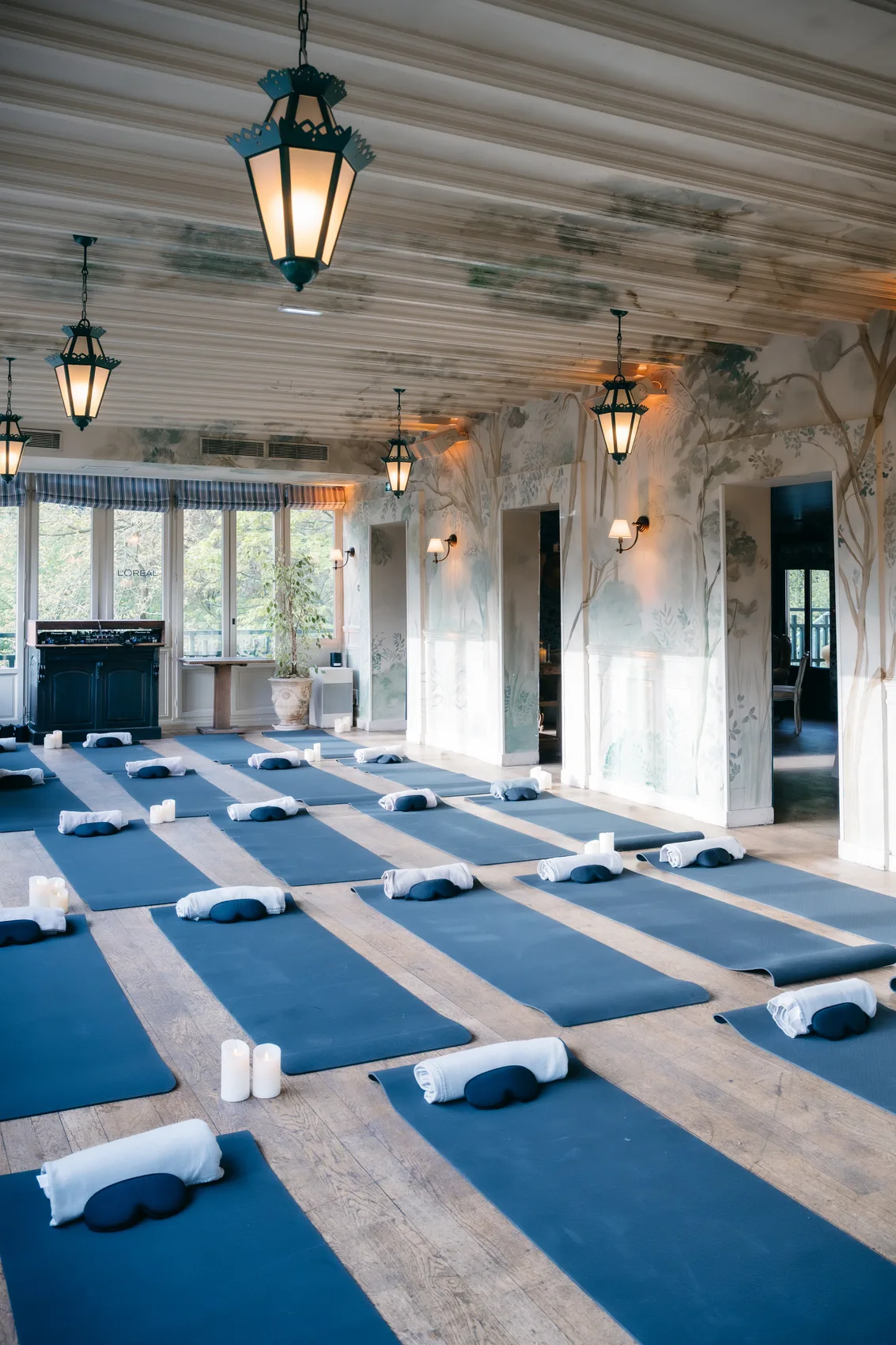
Everything is settled in advance, so your teams have nothing to manage. The practitioner arrives early, lays out the mats and the instruments, and checks the acoustics of the room. Participants lie down, the session is explained in a few words, then comes the immersion. At the end, a short return lets everyone find their feet before rejoining the day. On logistics we stay light: a quiet room, the ability to dim the lights, and a stretch of time protected from meetings. The rest (equipment, instruments, running order) we bring.
What occasions suit a sound bath?
Some moments lend themselves particularly well. The close of an intense quarter, when teams need to breathe out before starting again. An off-site or a team day, where the sound bath acts as a breath between two working sessions. The launch of a big project, to settle everyone before things speed up. A wellbeing week, obviously, where it stands out from the more expected workshops. We've even seen it close client evenings, as with a gong bath offered alongside a brand event. The common thread: offering a genuine stop, not another activity to tick off.
Is this a serious practice or a passing fashion?
We'd rather undersell it. That's more honest, and it lands better anyway. Sound replaces no psychosocial risk prevention framework, and we don't claim otherwise. What can be said is that the place of the arts in health and wellbeing is attracting growing interest. A WHO Europe synthesis (Fancourt & Finn, 2019) surveyed more than 900 publications, including around 200 reviews covering over 3,000 studies, and concludes that the arts can potentially contribute to health promotion and management, across the life course. The authors themselves note the heterogeneity of the evidence: it's a scoping review, mapping a field, not a demonstration.
We cite it in that spirit: as an encouraging signal, not a guarantee. For a team, the point stays simple and concrete: an hour to breathe out, together, with no screen and no demand to perform. The mechanism, on the body's side, is explained without jargon in sound baths and the nervous system.
“We set the room up. Your nervous system takes it from there.”
Who already uses these sessions?
Résonance has worked with demanding teams: L'Oréal (at a Luxe Vision Day), Polène, the Pullman Paris Tour Eiffel, Orange, Amarante, LinkedIn and 2L Collection. These formats are aimed at HR directors, wellbeing leads, office managers and event agencies looking for a credible pause, without the folklore. What recurs from one organisation to the next is the same thing: the surprise of seeing whole teams genuinely stop, and the appetite for doing it again.
Key points
- A simple wellbeing format: a quiet room, a protected slot, no prerequisites for participants.
- Two main formats: the studio privately (up to 8, from €350) or a session at your site (up to 40, €500–1,200, Paris & Île-de-France).
- Workplace stress has a real cost (estimated at €2–3 billion in France, INRS 2007 data): a genuine stretch of recovery isn't a gimmick.
- The effect is tracked simply, by before/after questionnaire: honest self-reported markers, not a clinical measure.
- A sound bath supports relaxation and recovery; it is neither medical treatment nor a promise of performance.
Giving your teams a real pause
At your site or at the private studio, across Paris and the Île-de-France. We scope it all with you, in advance.
Frequently asked questions from companies
How do I organise a gong bath at work?
How much does a corporate session cost?
How long does a session last?
How many people can take part?
Do we need any particular equipment or room?
Does a sound bath suit sceptical or complete-beginner colleagues?
Can it be built into an off-site or a team day?
Are there contraindications to flag to participants?
Sources
- INRS (with Arts et Métiers ParisTech), “Le stress au travail, conséquences pour l'entreprise”, the social cost of workplace stress in France estimated at between €2 and €3 billion (2007 data, minimum estimate).
- Fancourt D. & Finn S., “What is the evidence on the role of the arts in improving health and well-being? A scoping review”, WHO Regional Office for Europe (HEN synthesis report 67), 2019.
This article is for information. A sound bath is a wellbeing practice: it does not constitute a medical device or a psychosocial risk prevention measure, and it does not replace health support.
A team that genuinely allows itself to stop, even for an hour, leaves differently. It isn't another staff perk. It is, sometimes, the only moment in the week when nobody has anything to prove.